For those managing a desk at a private bank in Zurich, it is common for annual physical examinations to still be conducted in London or New York by a general practitioner with whom you have a longstanding relationship. The value of such continuity is undeniable.
However, what is often overlooked in expatriate schedules is the importance of establishing an internistic baseline in Zurich. This local assessment can address aspects that a once-a-year transatlantic visit may not fully capture: vascular age, advanced lipid profiles including Lipoprotein(a), sleep apnea screening, executive function, body composition, and a comprehensive report that your existing GP can efficiently review in twenty minutes.
What the Dein Team executive health check covers
How this differs from the cardiology-only executive assessment
A cardiac executive assessment answers a focused question: what is Your cardiovascular risk and is Your heart structurally and functionally sound. The internistic executive check answers a wider one: what is the full clinical baseline against which the next ten years should be measured. If Your concern is heart-focused (family history of early myocardial infarction, known elevated Lp(a), prior chest symptoms), Prof. Dr. Steffen Gloekler runs the Executive Cardiac Assessment at Dein Team Herzzentrum. For broader questions (sleep, fatigue, metabolic baseline, hormone status, executive function), the internistic check is the right entry point.
The European Society of Cardiology recommends formal cardiovascular risk estimation using SCORE2 or SCORE2-OP for asymptomatic adults aged 40 to 69 [Visseren et al., European Heart Journal 2021]. A 52-year-old non-smoking executive with a total cholesterol of 5.6 mmol/L and a systolic blood pressure of 132 mmHg sits at very different ten-year risks depending on whether his Lp(a) is 15 nmol/L or 250 nmol/L. That difference is genetic, causal, and changes treatment intensity [Reyes-Soffer et al., Arteriosclerosis Thrombosis and Vascular Biology 2022].
The half-day protocol in detail
You arrive between 7:30 and 8:00, fasting from the previous evening.
- Structured history (45 minutes). Personal and family medical history, current medications including supplements, occupational stressors, sleep, exercise tolerance, alcohol, recent travel, vaccination status.
- Physical examination (20 minutes). Thyroid palpation, cardiac auscultation, peripheral pulses, abdominal exam, basic neurological screen, skin survey.
- Laboratory panel (15 minutes for the draw, same-day results for most assays). CBC, full metabolic panel, lipid profile with apolipoprotein B and Lp(a), HbA1c, fasting glucose and insulin, TSH and free T4, ferritin, vitamin D, B12, folate, hsCRP, NT-proBNP, PSA on indication.
- Resting 12-lead ECG and 24-hour ambulatory blood pressure setup. A recorder is fitted and returned the next morning.
- Transthoracic echocardiogram (30 minutes). Structure, function, valves, diastolic parameters.
- Carotid-femoral pulse wave velocity (15 minutes). The reference non-invasive measurement of large-artery stiffness, an independent predictor of cardiovascular events and a useful marker of vascular ageing in patients without overt disease [Townsend et al., Hypertension 2015].
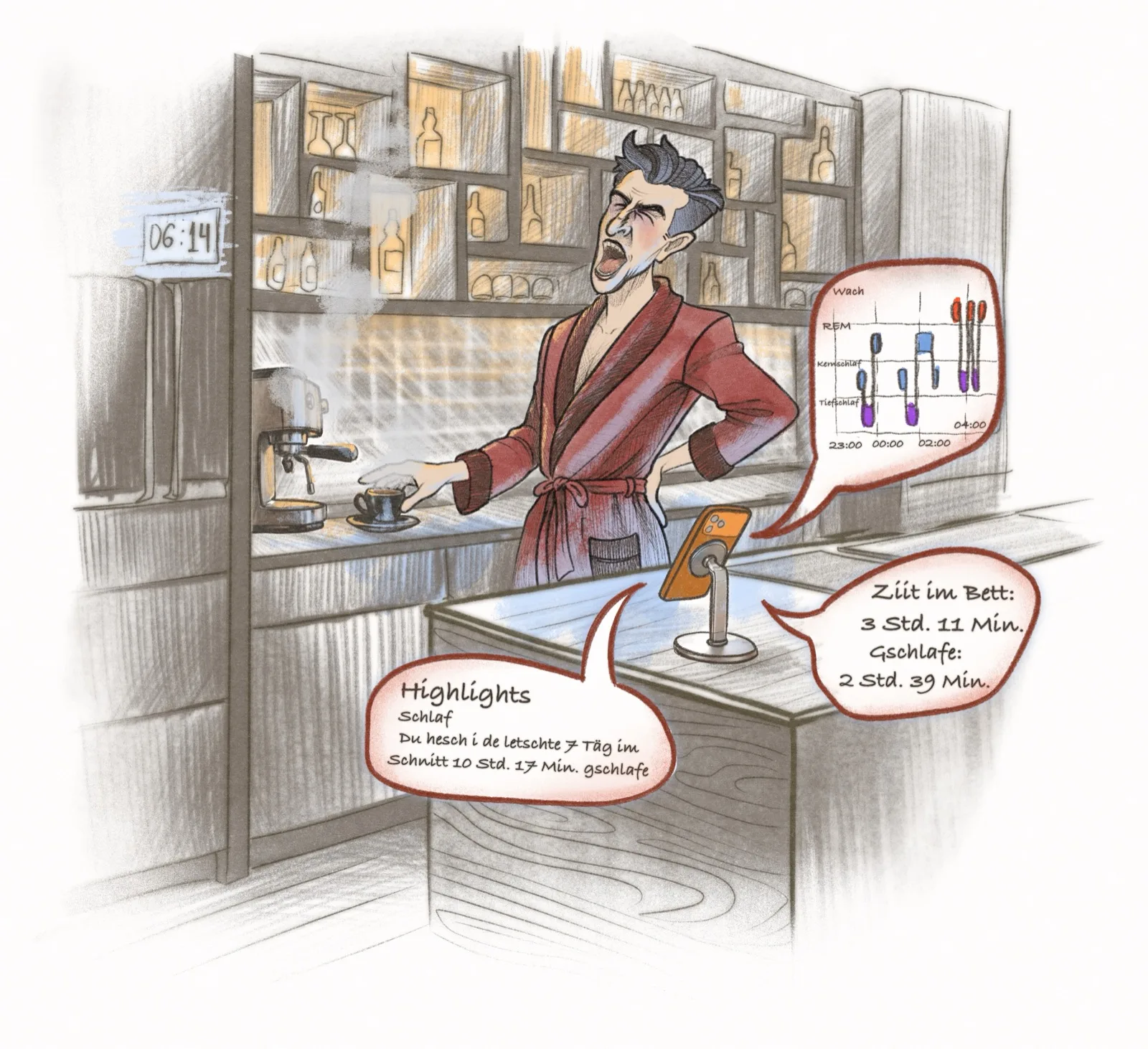
- Ambulatory polygraphy for sleep apnea screening. A take-home polygraphy device measures airflow, respiratory effort, oxygen saturation, and pulse. The American Academy of Sleep Medicine accepts home testing for adults with a high pretest probability of moderate-to-severe obstructive sleep apnea [Kapur et al., Journal of Clinical Sleep Medicine 2017].
- Body composition (15 minutes). Bioelectrical impedance with segmental analysis. DXA on indication.
- Executive function and burnout assessment (30 minutes). A structured interview around the three ICD-11 burn-out dimensions (energy depletion, mental distance from work, reduced professional efficacy) with validated screening instruments [WHO, ICD-11 QD85, 2019]. We look for the early pattern.
- Results discussion (45 minutes). We walk through every result that is back, frame the rest, and agree on the next steps in writing.
What the report contains and who reads it
The written report arrives in Your inbox within seven business days. It runs in three parts: a plain-English clinical summary readable by Your GP in twenty minutes, a data appendix with every value and reference range, and a decision plan with concrete next actions, indications, and timing.
:::pull-quote{author="Prof. Dr. C.K. Fritz" cite="DTL Zurich practice"} The report has to read like a letter between two physicians who respect each other. If Your GP in New York cannot make a decision from it, I have not done My job. :::
How Lipoprotein(a) changes the conversation
Lp(a) is a genetically determined lipoprotein that confers an independent, causal risk for atherosclerotic cardiovascular disease, with 70 to 90 percent of inter-individual variation set genetically [Reyes-Soffer et al., Arteriosclerosis Thrombosis and Vascular Biology 2022]. The 2018 AHA/ACC cholesterol guideline names Lp(a) at or above 125 nmol/L (approximately 50 mg/dL) as a risk-enhancing factor that supports starting or intensifying statin therapy in borderline or intermediate-risk patients [Grundy et al., Circulation 2019]. Lp(a) is largely set at birth and is measured once in a lifetime. Most adults in Zurich have never been measured. We measure it in every executive check; the result rewrites the lipid plan for roughly one in five patients.
Statins, lipids, and the global picture
The US Preventive Services Task Force recommends initiating low- to moderate-dose statin therapy for primary prevention in adults aged 40 to 75 with one or more cardiovascular risk factors and a 10-year risk of 10 percent or greater [USPSTF, JAMA 2022]. The European Society of Cardiology applies the same principle through the SCORE2 framework with a more granular intensity ladder [Visseren et al., European Heart Journal 2021]. The conversation usually centers on three numbers: Your LDL-C, Your apolipoprotein B, and Your Lp(a). We do not initiate medication on the day of the check unless You ask; the report gives Your GP a recommendation, and the prescription is a separate, deliberate conversation.
Diabetes, insulin sensitivity, and the prediabetes window
For metabolic risk we measure HbA1c and fasting glucose, adding fasting insulin where body composition or family history flags it. The Swiss Society of Endocrinology and Diabetology defines prediabetes as HbA1c 5.7 to 6.4 percent or fasting glucose 5.6 to 6.9 mmol/L [SGED/SSED, 2023]. That window is the highest-yield intervention point in the metabolic timeline. Lifestyle modification at this stage prevents or delays progression to type 2 diabetes in roughly half of cases.
How the visit integrates with Your London or New York GP
We assume You already have a GP at home and we are not trying to replace that relationship.
- Pre-visit. With Your consent we request the last two annual reports, the medication list, and recent imaging or specialist letters. We read them before You arrive.
- During the visit. Data is reported in the units Your GP uses (SI for European GPs, conventional for US GPs as a parallel column where useful).
- After the visit. The report goes to You, and to Your GP at home with Your written consent, by encrypted email.
Discreet handling of insurance and billing for international patients
Most senior expats sit in one of three configurations: Swiss compulsory health insurance plus a private supplement (Privatversicherung), an international private medical policy from a global carrier, or self-pay.
If You have a Swiss Privatversicherung, the check is typically billed as a self-pay package because the protocol exceeds what compulsory insurance covers for a healthy adult. Individual elements with a clear medical indication are billed through the standard Swiss tariff and the supplement covers the rest.
If Your insurance is international, we issue an English-language invoice with diagnosis codes and procedure codes that international carriers accept (Cigna, Bupa, Aetna International, Allianz Worldwide Care, and others). For some carriers we offer direct billing; for others You pay on the day and submit for reimbursement.
If You self-pay, the package price is fixed in advance. No add-ons billed after the fact. Investigations beyond the package (cardiac MRI, coronary CT angiography, endoscopy, specialist referrals) are discussed in the results conversation, and You decide whether to proceed.
All billing happens through the practice. Your name does not appear on any third-party platform.
Bridge to the cardiology side
If the check surfaces a finding that warrants cardiology depth (an abnormal echocardiogram, an Lp(a) that materially shifts risk, a suggestive ECG, a strong family history of early myocardial infarction), we refer directly to Prof. Dr. Steffen Gloekler. The handover is internal: shared records with Your consent, no second intake. Gloekler runs the cardiology-only Executive Cardiac Assessment which adds cardiopulmonary exercise testing, strain echocardiography, and where indicated coronary CT angiography or cardiac MRI.
:::pull-quote{author="Prof. Dr. C.K. Fritz" cite="DTL Zurich practice"} The right next step is rarely the most expensive imaging. It is the right one for Your specific data. We are paid for judgement, not for adding tests. :::
A simple decision rule for whether You need an executive check this year
You probably benefit from one if at least two of these are true: You have not had a full physical with up-to-date labs in the last 18 months; Your last cholesterol panel did not include Lp(a) or apolipoprotein B; You snore and wake unrefreshed more than two days a week; You are on three or more prescription medications; Your sleep, energy, or weight has shifted noticeably in the last six months; You have a first-degree relative who had a cardiovascular event before 60. Two or more on that list is enough to book.
Family inclusion
For senior executives who want their spouse and adult children seen at the same standard, we run a family-block format: same morning, same physician, protocol scaled to age. The decision is Yours; the structure exists if You want it.
Frequently asked questions
Is the executive health check covered by Swiss compulsory insurance?
Which language can the visit and the report be in?
How does follow-up work after the report?
Can my spouse and adult children be included?
How do You handle a second opinion if my GP at home disagrees with a recommendation?
Cluster context
Read further in the executive expat primary-care cluster: concierge GP positioning, Swiss private insurance for primary care explained in English, second opinions in internal medicine, and corporate health programs.
<a href="/en/contact" class="btn btn--primary">Book Your executive check</a>
Author: Prof. Dr. C.K. Fritz, M.Sc.
Allgemein & Innere Medizin, Schmerzmedizin · Practice Lead, Dein Team fürs Leben
Medically reviewed by: Prof. Dr. med. Steffen Glökler · FESC, MBA · FMH Kardiologie · Dein Team Herzzentrum · 4 May 2026