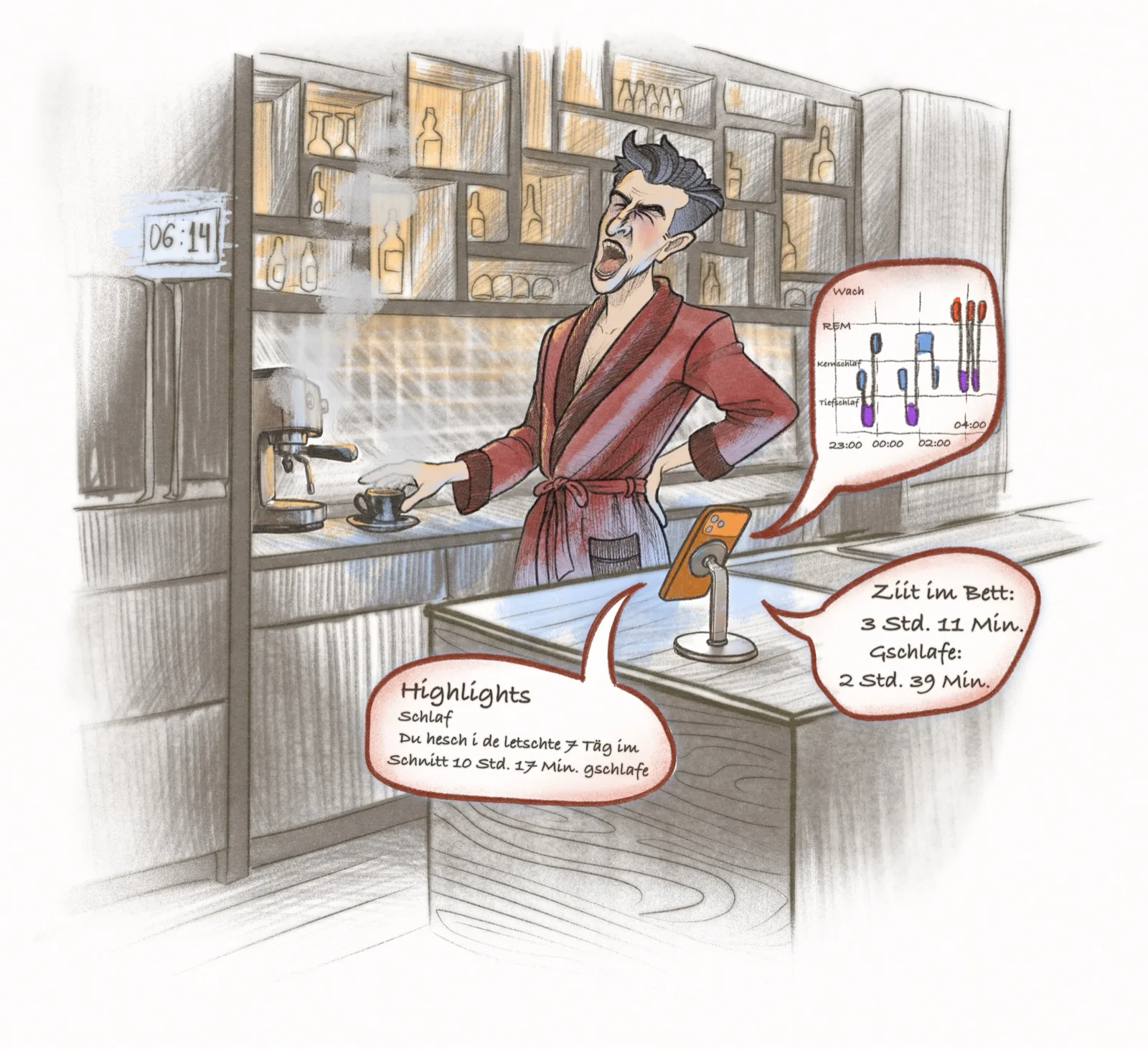
Men in Switzerland see their GP less often and later than women. That is statistics, not anecdote. And the price often only shows late: a heart attack at 54, prostate cancer at 62, a diabetes diagnosis after ten years of silent damage. Whether you look after your health is hardly the question. The question is whether you book the appointment years before the first symptom, or weeks after it. Here is what a modern men's health check actually delivers, from which age it makes sense, and why postponing is the real risk.
Why men often lose years on preventive care
Why men come later
In the consultation we typically see three patterns. The manager in his mid-fifties who has known for two years that his blood pressure is borderline and postpones it every Sunday. The father of two who has noticed the spot on his back for months and shows no one. The retiree who books his first appointment in eight years because his wife insists.
The reasons are well described in the research and are no Swiss peculiarity. Men wait longer between symptom onset and seeing a doctor, book fewer preventive appointments without a concrete reason, and more often skip recommended follow-up assessments [OECD 2023]. The image of the man who always keeps going plays its part. Anyone carrying responsibility at work rarely learns to speak openly about their own limits. Add a simple logistical truth. An hour-long preventive appointment, half of it history and half laboratory work and examination, is a hard sell in a packed calendar.
The result is clinically consistent. First cardiovascular events in men occur on average markedly earlier than in women, and a considerable proportion could have been prevented by consistent early detection and treatment of the standard risk factors [ESC 2021].
What a men's health check involves
A well-founded men's health check is a targeted stocktake of the areas where men statistically most often carry risks, and where early detection changes the course in a relevant way, rather than a screening battery of twenty modules. Smarter Medicine, the initiative of the Swiss Society of General Internal Medicine (SGAIM), reminds us that examinations without a clinical question lead to follow-up costs more often than to changes in treatment [SGAIM 2021]. The following areas belong in a sensible assessment.
- Cardiovascular risk assessment. Blood pressure by standardised protocol, resting ECG, lipid profile with LDL and HDL, HbA1c, fasting glucose. With a family history, a one-off Lp(a) test. The ESC guidelines recommend risk stratification with SCORE2 from the age of 40 [ESC 2021].
- Metabolism and abdominal fat. Waist circumference, liver values, kidney values, blood sugar. Visceral fat is a metabolically active organ and raises cardiometabolic risk independently of total body weight.
- Prostate history and PSA. Conversation about family history and urinary symptoms, PSA testing after counselling on benefits and limitations. The European urology guideline recommends a baseline PSA from 50, with a family history from 45 [EAU 2021].
- Testicular examination. Clinical examination, guidance on self-examination. Testicular cancer is the most common solid tumour in men between 20 and 40.
- Skin check. A clinical look at moles, suspicious lesions, shoulders and back (places the patient cannot easily see himself). Where something stands out, targeted dermatological follow-up.
- Mental strain. Structured conversation about sleep, stress level and mood. Sleep problems, irritability and exhaustion are often the first signs of relevant stress, long before physical symptoms dominate.
- Sleep and snoring. History of daytime sleepiness, loud snoring, pauses in breathing. With clinical suspicion, outpatient polygraphy to assess for sleep apnoea.
What does not belong in a health check matters just as much. A broad tumour-marker panel without a clinical question is no part of standard preventive care. Nor is whole-body MRI as routine screening. Both produce incidental findings with follow-up costs more often than clinically relevant diagnoses [SGAIM 2021].
From what age
A rigid age threshold cannot be justified clinically. What makes sense is an age-staged logic, adjusted for family history and occupation.
From 30, a first assessment with blood pressure, lipid profile and lifestyle history is worthwhile, above all if a parent had a cardiovascular event before 60. From 40, a structured internal medicine check with cardiovascular risk assessment per ESC recommendation makes sense, even without complaints. From 45, prostate history with PSA is added for those with a family history, from 50 for everyone. From 50, colorectal cancer screening is an established standard, in Switzerland either as a colonoscopy every ten years or as an immunochemical stool test every two years. From 65 the focus shifts; geriatric topics such as bone health, fall prevention and polypharmacy become more relevant.
With a family history, a simple rule applies. The first check should ideally happen ten years before the age at which the affected relative had their first event.
What is different at Dein Team
A men's health check with us is an internal medicine consultation rather than a fitness check. Here is what to expect.
Before the appointment you receive a written overview of the planned examinations and costs. The consultation is sized at 60 to 75 minutes so that history, clinical examination, ECG and blood sampling fit into one session. The report reaches you within five working days, with the values put into context and concrete recommendations. Where follow-up makes sense (sleep apnoea polygraphy, dermatological check, deeper cardiological work-up, urological referral), we coordinate the appointments directly. You have one point of contact rather than a scattered set of specialists.
In practice this means the following. Suspected sleep apnoea is evaluated together with Prof. Dr. Glökler; the outpatient polygraphy is interpreted from an internal medicine and a cardiological perspective. Abnormal lipid values with a family history lead to a one-off Lp(a) test, because Lp(a) is stable over a lifetime and only worth measuring once. Abnormal blood pressure readings are verified by 24-hour monitoring before drug treatment is discussed. The reception team handles billing and, if you work internationally, direct invoicing to your insurer.
When not to wait
There are symptoms for which postponing is no option. If one of these patterns applies to you, book the appointment this week rather than next quarter.
New chest tightness or pressure on the chest, especially on exertion. Breathlessness on efforts that used to be effortless. Blood in the stool or in the urine. A skin spot that is changing in shape, colour or size. A palpable lump in the testicle. Pain or frequent urination at night that disturbs sleep. Persistent exhaustion without identifiable cause that does not improve with rest. Sleep problems with snoring and daytime sleepiness. Acute neurological deficits such as difficulty speaking, sudden weakness or visual disturbance belong in the emergency department; there you dial 144, the Swiss emergency number.
This list is not exhaustive. The principle is this: a symptom that is on your mind belongs in a consultation, even if it seems harmless. Most of these assessments end with reassurance. That is exactly the point.
Written cost overview before your appointment
What an internal medicine check-up in Zürich costs, what compulsory basic insurance covers and what you pay yourself.
See costs and modulesFrequently asked questions
:::faq
How long does a men's health check at Dein Team take?
An internal medicine assessment with history, clinical examination, resting ECG and blood sampling usually takes 60 minutes. The report, with the results in context, reaches you within five working days.
Does basic insurance cover a men's health check?
Where there is a medical indication (symptoms, abnormal previous findings, family history, cardiometabolic risk), compulsory health insurance (Grundversicherung) covers the TARDOC services, the Swiss outpatient tariff, less your deductible (Franchise) and co-payment. A pure preventive check without indication is self-pay under every insurance tier. You receive a written cost overview before the appointment.
Should I have a PSA test?
A PSA test is worthwhile, but it belongs among the examinations with benefits and limitations. The European urology guideline recommends a baseline PSA from 50, with a family history from 45. Before the test we hold a counselling conversation about what the value can tell us, possible false-positive results and the consequences of a follow-up assessment. You decide, fully informed.
Do I need a referral from another doctor?
No. First contact with Dein Team fürs Leben is possible without a referral. If you already have a GP, we coordinate the report with that practice if you wish.
What happens if a finding is abnormal?
We discuss the finding with you, put it into clinical context and plan the next step. With cardiovascular suspicion, the deeper work-up takes place with Prof. Dr. Glökler. For dermatological, urological or gastroenterological findings we organise follow-up appointments in the DTL network practice or with a specialist colleague.
:::
Book a men's health check
First contact without a referral. Appointments usually within a week. For acute symptoms (persistent chest tightness, breathlessness, sudden neurological deficits) dial 144.
Book an appointmentProf. Dr. Craig K. Fritz M.Sc., Physician Associate for General Internal Medicine, Pain Medicine, Practice Lead Dein Team fürs Leben