In Switzerland, around 50 percent of men and 23 percent of women between 40 and 85 meet the thresholds for at least moderate sleep apnoea, as measured by home polysomnography in 2,121 people in the Lausanne HypnoLaus study [Heinzer R et al., Lancet Respir Med 2015]. For the USA, the Wisconsin cohort showed a relative rise in prevalence of 14 to 55 percent over two decades [Peppard PE et al., Am J Epidemiol 2013]. Most of these people have no idea. Snoring, daytime tiredness, poorly controlled blood pressure and waking at night gasping for air are put down to stress, age or a bad mattress for years. If you suspect sleep apnoea, you do not need a night in a hospital sleep laboratory. In most cases, a polygraphy test at home is enough.
What outpatient polygraphy does and when it is sufficient
When a home polygraphy is clinically sufficient
The right question is: how high is the pre-test probability of pure obstructive sleep apnoea? The 2017 AASM guideline is explicit here. In adults with a high clinical probability of moderate to severe obstructive sleep apnoea and no relevant comorbidity, home polygraphy is diagnostically on a par with polysomnography [Kapur VK et al., J Clin Sleep Med 2017]. Pre-test probability is high when three conditions coincide.
- Loud habitual snoring plus witnessed pauses in breathing. If your partner reports that you repeatedly stop breathing for several seconds at night and then start again with a gasp, that is a clinically strong signal. If you sleep alone, a smartphone sleep log with audio recording over two weeks can substitute.
- Daytime tiredness or involuntarily nodding off in passive situations. Assessed with the Epworth Sleepiness Scale, a validated eight-item self-report questionnaire. Scores of 11 or more point to relevant daytime sleepiness. Scores of 16 or more are considered problematic under Swiss fitness-to-drive rules [BAG, VZV Annex 1].
- An additional risk feature. BMI of 30 or more, neck circumference of 43 cm or more in men or 41 cm or more in women, hard-to-control high blood pressure, confirmed coronary heart disease, atrial fibrillation or type 2 diabetes. Each of these shifts the pre-test probability markedly upwards.
If all three constellations are present, polygraphy is the right first tool. If only one is present, we clarify in the consultation first. Sometimes a different main question emerges, such as iron deficiency or an underactive thyroid. Polygraphy without a clinical question is wasted diagnostics.
What the device measures and how we get it to your home
The devices we use at Dein Team are type III polygraphs under the AASM classification: the ResMed ApneaLink Air and the Philips Alice NightOne. Both record the same data set; both are validated for outpatient diagnosis of obstructive sleep apnoea [Kapur VK et al., J Clin Sleep Med 2017].
- Nasal airflow. A small pressure cannula in the nostrils measures the air stream. Apnoeas (complete cessation of breathing for at least 10 seconds) and hypopnoeas (a reduction in airflow of at least 30 percent for at least 10 seconds followed by a drop in oxygen) are calculated from this.
- Pulse oximetry. A finger clip measures oxygen saturation continuously. Desaturation episodes are the haemodynamically most important correlate of an apnoea.
- Breathing movements of chest and abdomen. Two elastic belts detect whether the chest is moving. This distinguishes an obstructive apnoea (the chest is working, airflow is absent) from an apnoea that originates in the respiratory centre (the chest stays still because the command to breathe is never sent). Clinically an important difference.
- Snoring sounds and position. A microphone and a position sensor capture the noise and whether the apnoeas are position-dependent. Some patients only have apnoeas when lying on their back.
- Heart rate. Via photoplethysmography at the finger. A first look at rhythm abnormalities during the night; no substitute for a 12-lead ECG.
You collect the device from us at the practice. Fitting takes around ten minutes, with written instructions and a short video. You sleep in your own bed. The next day, you bring the device back. Analysis within two to three working days.
What the AHI thresholds mean clinically
The apnoea-hypopnoea index is the key figure in sleep medicine. It states how many apnoeas plus hypopnoeas occur per hour of sleep. The AASM thresholds have been internationally established since 2012 and are used identically in the HypnoLaus study [Heinzer R et al., Lancet Respir Med 2015; Kapur VK et al., J Clin Sleep Med 2017].
- AHI below 5 per hour. No sleep apnoea by definition. If symptoms persist, we look elsewhere for the cause. Iron, thyroid, mood regulation, sleep hygiene, periodic limb movements.
- AHI 5 to 14.9 per hour · mild. Treatment indication depends on symptoms and comorbidity. With clear daytime tiredness, high blood pressure or cardiovascular risk we treat; with an isolated finding and no complaints we monitor.
- AHI 15 to 29.9 per hour · moderate. Treatment is usually indicated. With cardiovascular risk, the indication is clear.
- AHI 30 or more per hour · severe. Clear indication for treatment. With severe daytime tiredness there are implications for fitness to drive, which we discuss with you [BAG, VZV Annex 1].
In the majority of cases, treatment means positive airway pressure through a nasal mask (CPAP) during sleep. For position-dependent apnoea, positional therapy and weight reduction are the first steps. For mild apnoea with a supine component, a mandibular advancement splint is an alternative. We settle which option fits in the follow-up consultation. If there is a cardiovascular finding, we bring cardiology in.
Why untreated sleep apnoea attacks the heart
This is the real reason polygraphy is not a comfort issue. Untreated moderate to severe obstructive sleep apnoea is an established cardiovascular risk factor.
In patients with treatment-resistant hypertension, obstructive sleep apnoea is the most common secondary cause. It outnumbers hyperaldosteronism, renal artery stenosis and phaeochromocytoma combined.
There are three cardiovascular consequences.
High blood pressure. Repeated pauses in breathing at night trigger drops in oxygen, sympathetic activation and blood pressure spikes. Over months, the day-night profile shifts, the nocturnal fall in blood pressure is lost (non-dipping) and daytime blood pressure rises. In treatment-resistant hypertension, meaning three antihypertensives including a diuretic fail to reach targets, obstructive sleep apnoea is the most common secondary cause. In the study by Pedrosa and Drager, 64 percent of patients with resistant hypertension had a previously undiagnosed sleep apnoea [Pedrosa RP et al., Hypertension 2011]. The 2023 ESH guideline on arterial hypertension lists OSA as a significant secondary contributor to hypertension and names obesity and metabolic syndrome as the main reversible risk factors [Mancia G et al., J Hypertens 2023].
Atrial fibrillation. Several cohorts show that patients with obstructive sleep apnoea have an increased risk of new-onset atrial fibrillation. In the Olmsted County cohort, among people under 60, severe nocturnal oxygen desaturation was associated with a significantly higher risk of incident atrial fibrillation, independent of BMI and high blood pressure [Gami AS et al., JACC 2007]. Clinically: if a patient under 60 has new-onset atrial fibrillation, the question of sleep apnoea belongs in the standard work-up.
Myocardial infarction risk. Severe obstructive sleep apnoea is associated with a higher incidence of coronary events [Heinzer R et al., Lancet Respir Med 2015]. The mechanisms are nocturnal sympathetic activation, endothelial dysfunction, insulin resistance and prothrombotic changes.
This is where the bridge to cardiology is built. If your polygraphy result shows an AHI of 15 or more and you also have hard-to-control high blood pressure, atrial fibrillation or known coronary heart disease, the result goes to Prof. Dr. Glökler in parallel. Sleep apnoea without a cardiology assessment in this constellation leaves part of the risk on the table.
When the sleep laboratory is the right tool
Home polygraphy is good enough for the majority of patients with a high pre-test probability of pure obstructive sleep apnoea. It is insufficient in four constellations, where we refer to a sleep medicine centre for full polysomnography [Kapur VK et al., J Clin Sleep Med 2017].
- Suspected breathing disorders originating in the respiratory centre, or a mixed breathing pattern. In advanced heart failure, after a stroke or under opioid therapy. Here, polygraphy does not deliver all the information treatment requires.
- Suspected other primary sleep disorders. Restless legs syndrome with periodic limb movements, REM sleep behaviour disorder, narcoleptic symptoms. These need EEG recording, which an outpatient polygraph lacks.
- Hypoventilation syndromes. Obesity hypoventilation, neuromuscular disease, severe COPD with nocturnal hypercapnia. Here, transcutaneous CO₂ measurement is also needed.
- Home polygraphy technically unusable or clinically inconsistent. If the device records too little sleep time, the AHI is well below clinical expectation, or the symptoms strongly suggest sleep apnoea despite a negative result. Then full polysomnography is the next step.
In Zürich we refer, where needed, to Pulmonology and the Sleep Centre at the University Hospital, the pulmonology sleep laboratory at Klinik Hirslanden or the Sleep Medicine Centre at Stadtspital Triemli. Which one fits depends on insurance, place of residence and comorbidity.
Where to read on in the cluster
Sleep apnoea is never an isolated topic. It is tied to snoring, daytime tiredness, blood pressure control and fatigue syndromes. The DTL knowledge section covers these neighbouring topics:
- Snoring and daytime tiredness · when it is sleep apnoea. When sawing logs every night is more than a relationship problem.
- Measuring your own blood pressure · the decision rule. 24-hour profile, home measurement and when to escalate.
- Chronic tiredness · the internal medicine differential diagnosis. Iron, thyroid, sleep, burnout, depression in the right order.
- Type 2 diabetes with GP support. Insulin resistance and sleep apnoea are neighbours, not strangers.
The cardiology side of this question sits with the sister hub: Sleep apnoea and heart attack risk on dth.healthcare and High blood pressure and the path to cardiology.
Frequently asked questions
Does health insurance cover a home polygraphy test?
Do I have to spend a night in hospital for a polygraphy test?
How quickly can I get an appointment?
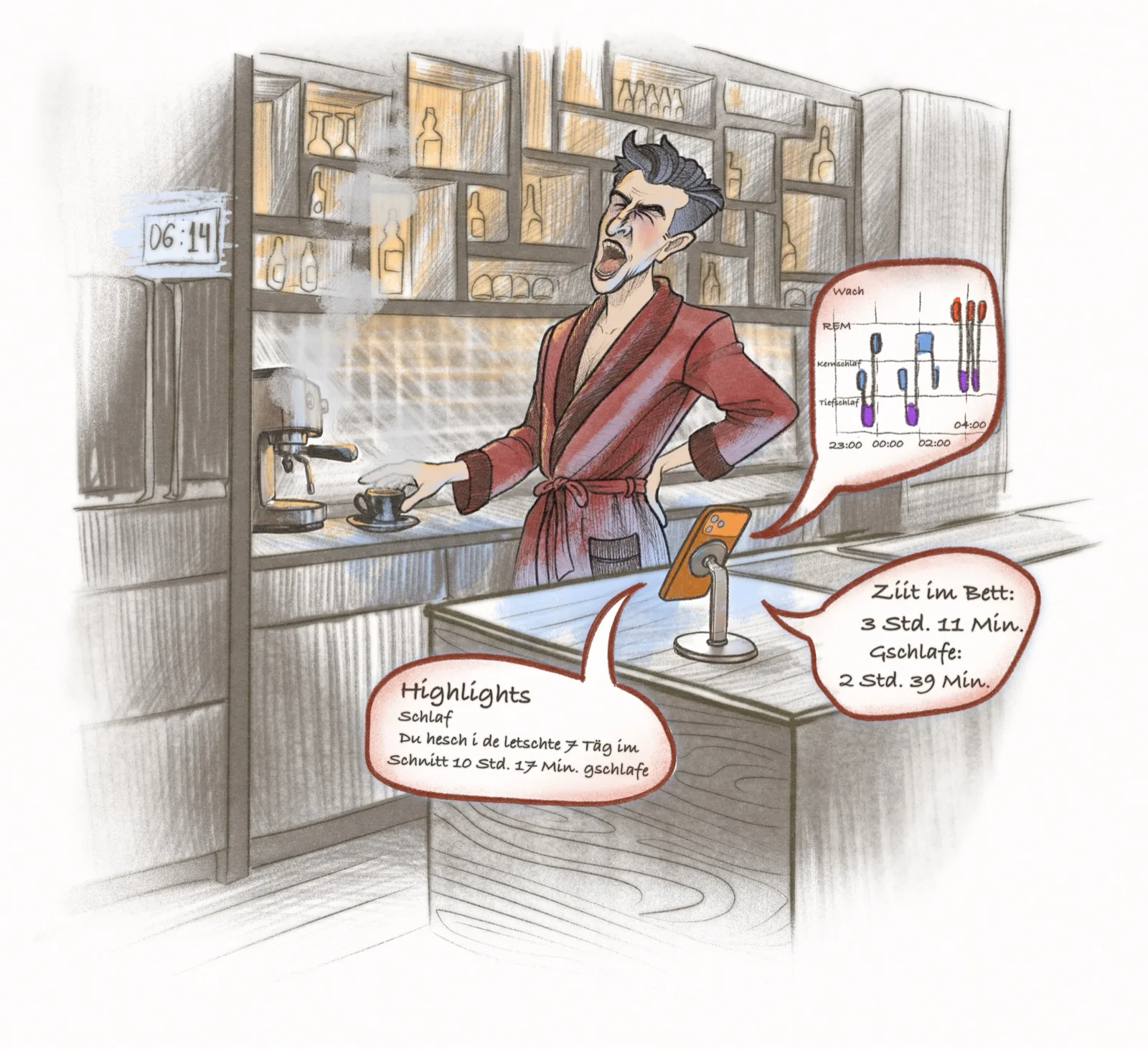
My wearable shows drops in oxygen at night. Is that enough for a diagnosis?
What does it all cost if I have private insurance?
What if the result is negative but I still feel tired?
Am I automatically banned from driving after a positive result?
Sleep apnoea screening at Dein Team
Outpatient polygraphy at home, interpreted by Prof. Dr. Fritz and Prof. Dr. Glökler. If there is a cardiovascular concern, a second assessment by Prof. Dr. Glökler. First contact without a referral. Appointment usually within a week. In case of acute shortness of breath or persistent chest pressure, dial 144.
Book a screening appointmentAuthor: Prof. Dr. C.K. Fritz, M.Sc., Pain Medicine, Practice Lead, Dein Team fürs Leben, Zürich. Medically reviewed by: Prof. Dr. med. Steffen Glökler, FESC, MBA, FMH Cardiology, on 4 May 2026. Last updated: 4 May 2026.