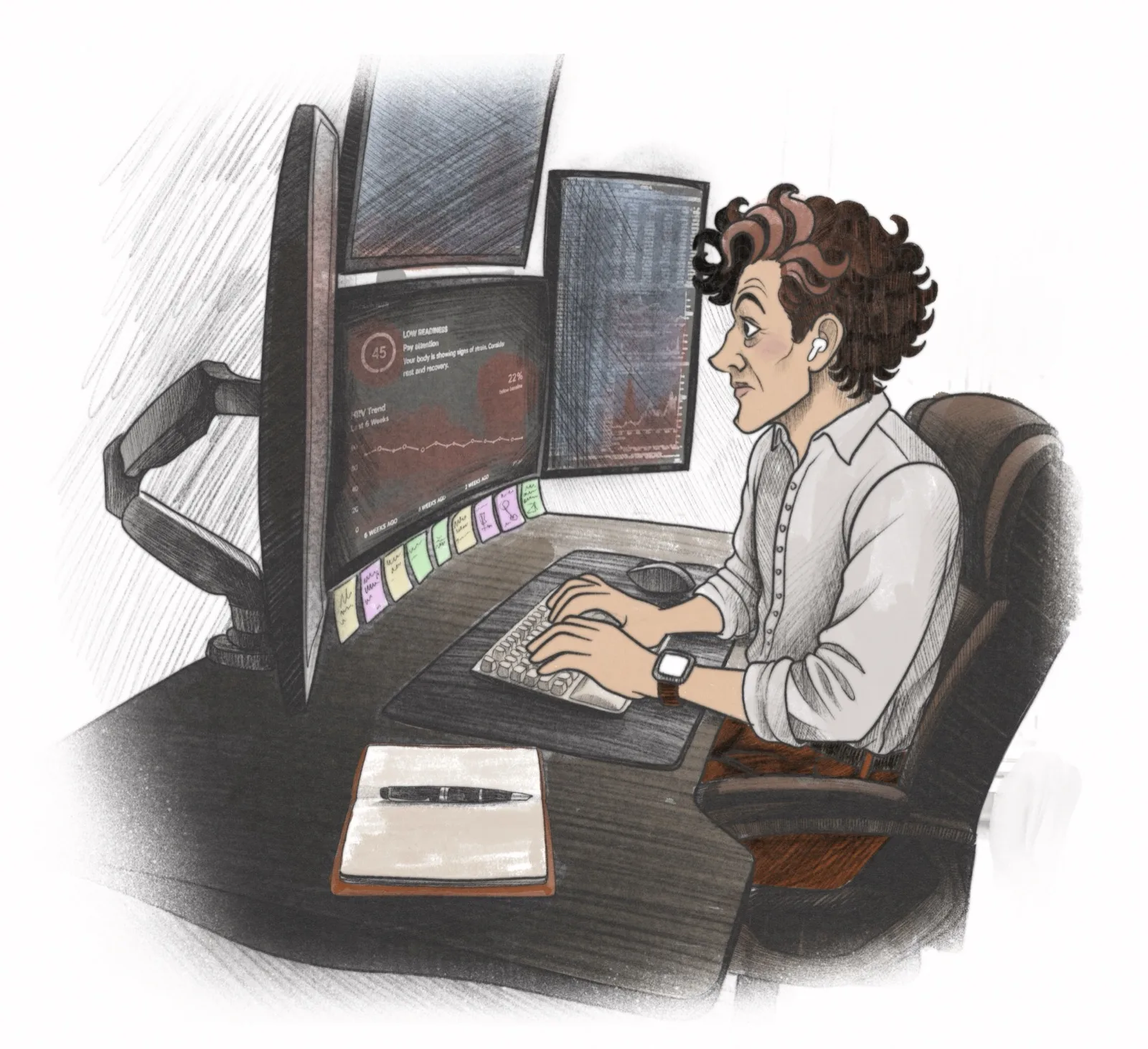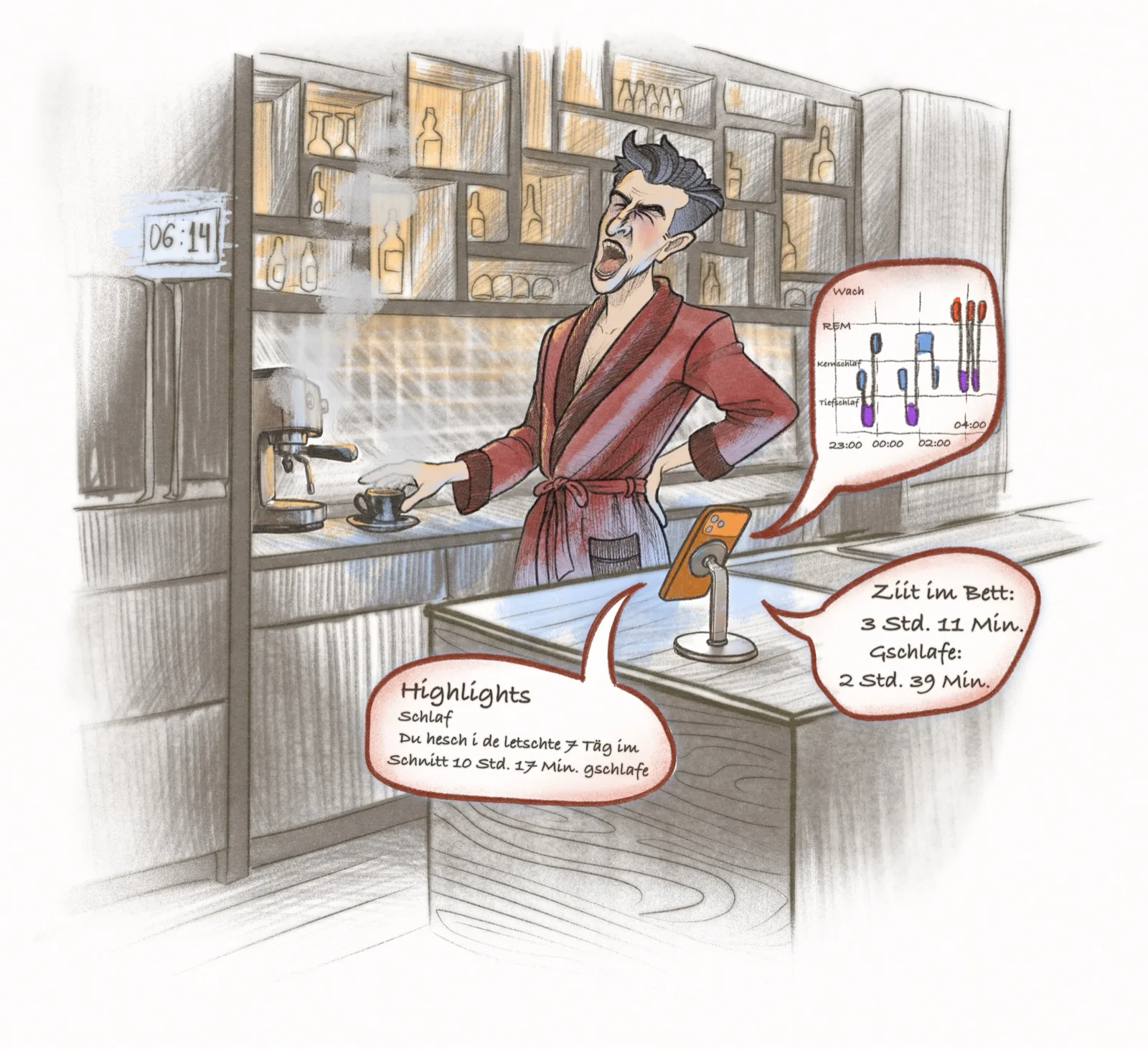
You have been tired for months. Sleep no longer restores you. The weekend is not enough. You go to your GP, the lab results come back, everything is within the normal range, and you hear the sentence that is meant to reassure and does the opposite: "From an internal medicine point of view, everything is fine." This is where a different kind of diagnostics begins. It does not measure what shows up in standard laboratory values. It measures how your autonomic nervous system responds to an ordinary working day. A feeling becomes a finding you can work with.
What HRV-based stress measurement delivers diagnostically
Subjective feeling and objective data belong together
Tiredness is a subjective perception. It cannot be measured, only described. That is precisely the problem in the consulting room: two patients say the same sentence ("I can't go on"), and the physical correlate behind it can look completely different. In one, autonomic regulation is intact and the exhaustion resolves after a break. In the other, the autonomic nervous system has slipped into a rigid state of constant activation from which it cannot find its way out without structured intervention.
The standard internal medicine workup covers part of this differentiation through the laboratory: thyroid, iron, vitamin B12, vitamin D, inflammatory markers, blood sugar, liver and kidney values. When everything there is unremarkable, a gap remains. That gap is autonomic function. A conventional routine lab panel does not capture it, because as a regulatory capacity it is not a metabolic parameter. HRV-based stress measurement fills this gap. It complements the internal medicine workup rather than replacing it.
In practice, this means we first carry out the basic GP diagnostics (laboratory, ECG, clinical status, structured history of the three ICD-11 dimensions of exhaustion, mental distance and reduced performance) [WHO ICD-11 QD85, 2019]. Once somatic causes have been excluded or treated and the symptoms persist, the next step follows: looking at the autonomic nervous system objectively.
HRV as a window onto the autonomic nervous system
HRV is not a new concept. The international Task Force of the ESC and NASPE defined the standards for measurement and interpretation back in 1996 [Task Force ESC/NASPE, European Heart Journal 1996]. What has developed since then is the hardware: hospital Holter ECGs have become wearable, ambulatory sensors with high data quality.
What HRV reflects is the balance between the sympathetic system (tension) and the parasympathetic system (recovery), measured through beat-to-beat variation. The most important parameters that appear in the evaluation are SDNN (the standard deviation of all normal-beat intervals over 24 hours, a measure of overall variability), RMSSD (the mean difference between successive beats, parasympathetically dominated), and the frequency bands LF and HF (low-frequency and high-frequency power, which reflect different components of autonomic tone) [Shaffer and Ginsberg, Frontiers in Public Health 2017].
A meta-analysis of 37 studies with several thousand participants in total showed that people under chronic stress have systematically reduced HRV, most clearly in the parasympathetic components [Kim et al., Psychiatry Investigation 2018]. A Swedish study of patients with clinically diagnosed burnout found reduced HRV values compared with healthy controls, particularly in the high-frequency range [Lennartsson et al., International Journal of Psychophysiology 2016]. These findings are not specific to burnout; they show a general state of chronic autonomic activation. That very lack of specificity is the diagnostic value: HRV cannot tell you whether you have burnout. What it can tell you is how your body is regulating right now.
An important caveat on interpretation: normative HRV values depend heavily on age, sex, fitness level, medication and measurement method. An isolated SDNN figure without clinical context says little. The evaluation belongs in the hands of someone who knows the range, accounts for the individual confounders and places the finding within the clinical course. This is exactly what the specialised occupational physicians who produce the evismo report do, and we combine it with the clinical picture in the consultation.
The cortisol day profile as a second axis
Cortisol is the second pillar of objective stress diagnostics. It follows a pronounced circadian rhythm, with a high value shortly after waking and a gentle decline over the day, reaching its lowest point in the first half of the night. Under chronic strain this profile typically changes: the cortisol awakening response (CAR) can be raised or blunted, and the daytime decline flattens ("flatter diurnal slope") [Chida and Steptoe, Biological Psychology 2009].
A meta-analysis of 80 studies with 179 associations linked a flatter daytime decline to a series of unfavourable health indicators (depressive symptoms, cardiovascular endpoints, immunological markers, general fatigue), with the largest effect size found for immunological and inflammatory endpoints [Adam et al., Psychoneuroendocrinology 2017]. This makes the cortisol day profile a clinically usable marker.
The sensible method is saliva sampling, which you do at home on a representative day (typically immediately after waking, 30 minutes later, at midday, in the evening and at night). The analysis is carried out in the laboratory. The same caveat applies here: a single day curve is not sufficient for every question, and confounders such as shift work, oral contraceptives, glucocorticoid medication or acute infections distort the picture. We establish the indication together in the consultation, and the result comes back with context.
How we measure and interpret at Dein Team fürs Leben
- First consultation in the practice. A structured history of the three ICD-11 dimensions of exhaustion, mental distance and reduced performance, plus your sleep, work and recovery patterns. We decide together whether HRV measurement makes diagnostic sense or whether other steps should come first.
- Basic internal medicine diagnostics. Laboratory (TSH, ferritin, B12, vitamin D, hsCRP, full blood count, HbA1c, liver, kidney), resting ECG, physical examination. If a somatic cause emerges here (hypothyroidism, iron deficiency, untreated sleep apnoea), it is addressed first.
- 24-hour HRV measurement in everyday life. Three adhesive electrodes, a small waterproof sensor, one normal working day and one night. Alongside it, a short digital diary via an app: work, exercise, rest, sleep. The diary is the key to making the data clinically interpretable.
- Cortisol day profile where indicated. Four to five saliva samples across a representative day, analysed in the laboratory. Indicated where we suspect a marked endocrine component, where the HRV evaluation shows a flat recovery curve, or where a sleep disorder involves pronounced early-morning waking.
- Evaluation by specialised occupational physicians. The HRV report maps the phases of strain and recovery, the sleep structure and the overall autonomic picture to your specific diary. In the consultation we combine it with the clinical findings, laboratory results and cortisol profile.
- Results discussion and a concrete plan. What the data show, where the levers lie, which steps make sense. Lifestyle interventions (sleep, exercise, defined recovery windows), structured methods (breathing and mindfulness training with a demonstrably measurable effect on HRV), or referral to psychotherapy and psychosomatic medicine. If we suspect an additional cardiac component (heart rhythm disorder, exertion-related symptoms), cardiological assessment takes place through Dein Team Herzzentrum.
On the question of cost: an HRV measurement with a medical indication and evaluation is usually billed through basic health insurance (Grundversicherung). Reception clarifies the billing with you in advance.
Mental health at Dein Team fürs Leben
Internal medicine, body-based diagnostics for chronic stress and impending burnout. From the first consultation to a structured plan. Co-Lead Prof. Dr. C.K. Fritz and the team.
Mental health consultationWhat the measurement changes, clinically and personally
What patients often describe when they hold the report in their hands: for the first time in months, they see on a curve what they feel physically. That changes the basis of the conversation. Instead of talking about a vague "stress", we talk about specific hours of a specific day in which the recovery curve stayed flat. Instead of guessing whether the night was restorative, we see whether deep relaxation sets in during sleep. Instead of speculating whether "switching off at the weekend" works, we see whether it works.
That is the real value of the diagnostics. It makes everyday life addressable. The treatment that follows looks much the same as it would without the measurement. It is simply more targeted. And it can be checked: a follow-up measurement after three to six months shows whether the changes in lifestyle and treatment are reaching the autonomic nervous system.
:::faq
Is the HRV measurement the same as what my Apple Watch or my Garmin shows?
No. Consumer wearables measure HRV in a heavily abbreviated form, often only at night or in short intervals, using optical sensors at the wrist. That is useful for a rough trend but does not hold up for a medical assessment. Clinical HRV measurement runs on an ECG-based system with adhesive electrodes, continuous recording and medical evaluation. If your watch shows you unusual values, treat that as a reason to have a proper measurement done. It is no substitute for one.
How long does the diagnostic process take in total?
From first consultation to results discussion, typically two to three weeks. First consultation and fitting of the sensor at one appointment, 24 hours of recording, a few working days for evaluation, then the results discussion.
Does basic health insurance cover the costs?
With a medical indication, usually yes. This applies to both the HRV measurement and a cortisol day profile with a medical question behind it. Reception clarifies this in advance.
What if the values are normal and I am still exhausted?
This happens, and it is clinically important. A normal HRV does not rule out the exhaustion you experience; it only shifts the diagnostic focus. We then look more closely at sleep architecture (polygraphy where appropriate), at depressive symptoms, at chronic pain or other dimensions of exhaustion. The consultation does not end because one measurement comes back normal.
Can I have the measurement done if I take beta blockers or antidepressants?
Both alter HRV systematically and must be taken into account in the evaluation. The measurement remains worthwhile; the result is read in the light of your medication. Please bring a complete list of your medications to the first consultation.
:::
Consultation at Dein Team fürs Leben
If you recognise yourself in the symptoms described and the assessments so far have come back unremarkable, the first consultation is the next step. An appointment is usually available within a week. In case of acute suicidal thoughts or acute chest tightness, dial 144.
Book an appointmentProf. Dr. Craig K. Fritz M.Sc. · Physician Associate for General Internal Medicine, Pain Medicine, Practice Lead Dein Team fürs Leben