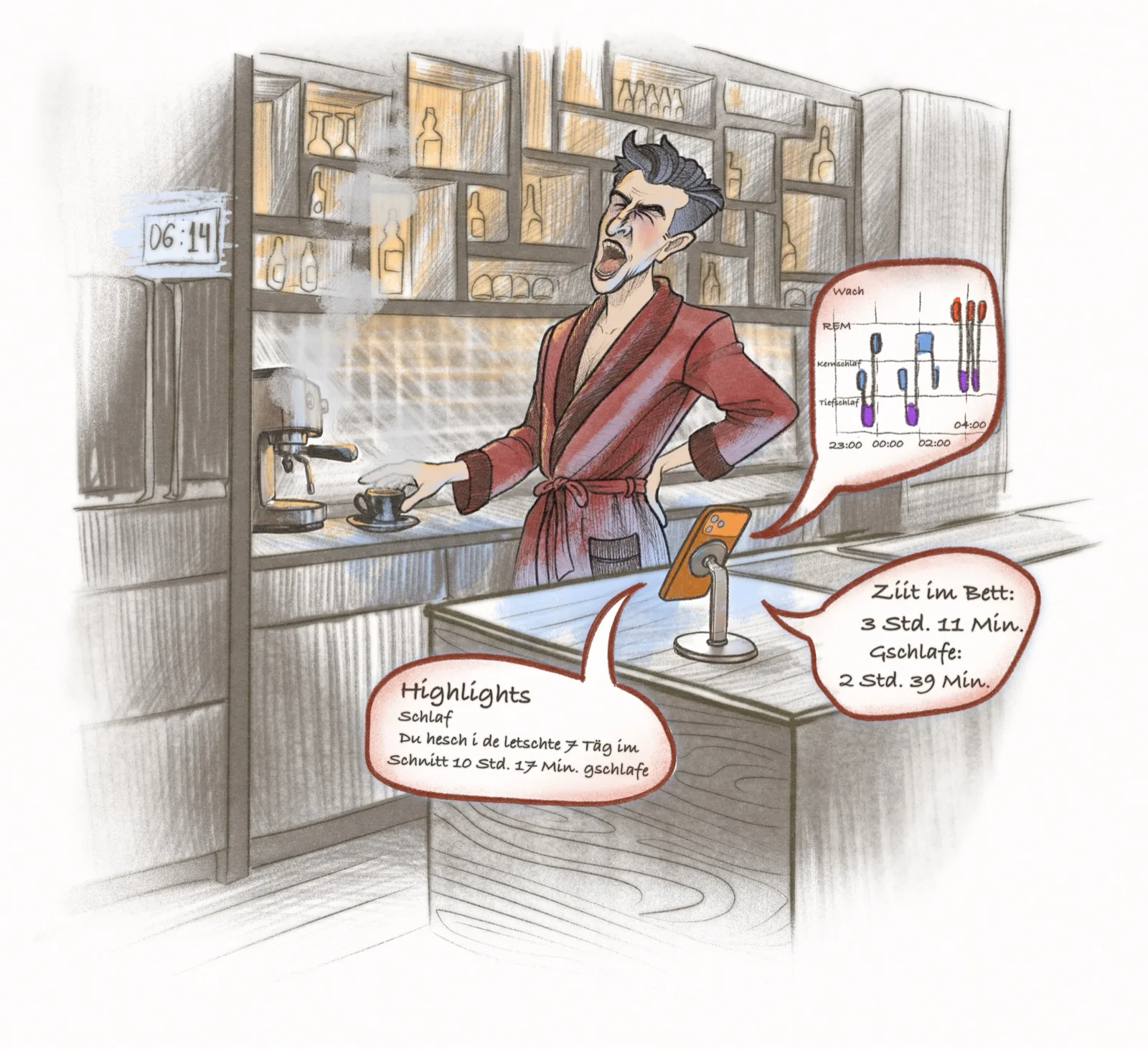
You have felt exhausted for months, even though you get enough sleep. Your concentration at work is slipping, and simple tasks cost more energy than they used to. Perhaps you notice a slight tingling in your fingertips or toes, or sometimes numbness. The blood count at your GP came back "normal", and yet there is this diffuse fatigue you cannot place. A deficiency of vitamin B12 or folic acid is a common, readily treatable cause of these complaints. It gets missed because the standard routine values only reveal it at a late stage.
What vitamin B12 and folic acid actually do
Symptoms that deserve to be taken seriously
A B12 or folate deficiency develops gradually. The body's stores typically last several years for B12 and a few months for folic acid. Symptoms often appear only once the stores are largely depleted, and they are easily dismissed as stress, lack of sleep or normal ageing.
Haematological signs are fatigue, breathlessness on exertion, pallor, palpitations and reduced physical performance. The classic laboratory finding is a macrocytic anaemia with an elevated MCV. An important caveat: in around a quarter of patients with a confirmed B12 deficiency, the MCV is initially normal, and the classic anaemia may be absent [Stabler SP, NEJM 2013]. A normal full blood count therefore does not rule out a deficiency.
Neurological signs are particularly relevant in B12 deficiency. They range from symmetrical tingling and numbness in the hands and feet (polyneuropathy) through unsteady gait and impaired position sense to concentration problems, forgetfulness and depressed mood. In advanced cases, subacute combined degeneration of the spinal cord can develop, a lesion of the posterior columns. If this is not treated in time, neurological deficits frequently remain permanent [Green R et al., Nat Rev Dis Primers 2017]. This is exactly why neurological symptoms call for prompt investigation rather than waiting.
Physical clues such as a smooth, red, burning tongue (Hunter's glossitis), cracked corners of the mouth or loss of appetite are rarer, yet specific enough to suggest a deficiency.
- Persistent fatigue and impaired concentration that do not improve with sleep.
- Tingling or numbness in the hands or feet, symmetrical on both sides.
- Unsteady gait or feeling unsteady on your feet in the dark.
- A vegan or strict vegetarian diet without supplemented B12.
- Age over 60, particularly with reduced appetite or known gastritis.
- Long-term use of metformin or acid blockers (omeprazole, pantoprazole and other PPIs).
Why the routine values are not enough. Holo-transcobalamin, MMA and homocysteine
The classic serum B12 value (total cobalamin) measures the total amount circulating in the blood. The problem: only around 20 percent of the B12 in the blood is biologically active and available to the cells, bound to the transport protein transcobalamin (holo-transcobalamin, or holo-TC for short). The remainder is bound to haptocorrin and is barely utilised. A serum B12 value in the "lower normal range" can therefore mask a functional deficiency [Devalia V et al., Br J Haematol 2014].
Modern stepwise diagnostics therefore use three markers in combination.
First, holo-transcobalamin. This value reflects the active B12 that is available to the cells. It falls earlier than total B12 and is the most sensitive first-line marker for an early deficiency [Devalia V et al., Br J Haematol 2014].
Second, methylmalonic acid (MMA). MMA is a metabolic product that accumulates when B12 is lacking inside the cell. MMA rises in a functional B12 deficiency even when serum B12 is still within the normal range. MMA is therefore a confirmatory functional marker and is particularly helpful with borderline results [Stabler SP, NEJM 2013; Devalia V et al., Br J Haematol 2014].
Third, homocysteine. Homocysteine rises in a deficiency of B12 or folic acid (and also in B6 deficiency or renal insufficiency). It is less specific than MMA, but it helps to assess both vitamins together and has an independent cardiovascular significance as a risk marker [Green R et al., Nat Rev Dis Primers 2017].
For folic acid, the red cell folate value (erythrocyte folate, "RBC folate") is more informative than serum folate alone. It reflects the stored reserve of the past weeks, whereas serum folate fluctuates from day to day and can appear misleadingly high shortly after a folate-rich meal [Devalia V et al., Br J Haematol 2014].
Infusion therapy. When the stores need to be replenished quickly and safely
For a confirmed severe deficiency, neurological symptoms or an established malabsorption disorder, parenteral therapy (intramuscular or as an infusion) is the fastest and most reliable way to replenish the stores. At Dein Team fürs Leben, the indication is established on the basis of targeted diagnostics rather than on suspicion.
Service. Infusion therapiesDiagnostics in practice. History before lab tests
The indication for extended B12 diagnostics rests on four pillars: the clinical picture, dietary history, medication history and pre-existing conditions.
Dietary history. Vegans and strict vegetarians are particularly affected because B12 occurs almost exclusively in animal foods. The Federal Food Safety and Veterinary Office (BLV) explicitly points out that a vegan diet without B12 supplementation leads to a deficiency in the long run, and recommends regular supplementation as well as periodic checks of B12 levels [BLV, Bund].
Medication history. Long-term use of metformin measurably reduces intestinal B12 absorption and, after several years, leads to a deficiency in a relevant proportion of patients. In the placebo-controlled HOME study, metformin was associated after 4.3 years with an absolute increase in the frequency of B12 deficiency of around 7 percentage points [de Jager J et al., BMJ 2010]. Proton pump inhibitors (PPIs, for example omeprazole, pantoprazole, esomeprazole) lower stomach acid and with it the release of B12 from food; use for more than two years significantly increases the risk of deficiency [Lam JR et al., JAMA 2013].
Pre-existing conditions. Atrophic gastritis, pernicious anaemia (autoimmune gastritis with intrinsic factor deficiency), Crohn's disease involving the ileum, coeliac disease, previous gastric or ileal resection and chronic pancreatitis are classic malabsorption disorders. Where pernicious anaemia is suspected, we add the measurement of anti-intrinsic factor antibodies and, where appropriate, anti-parietal cell antibodies [Stabler SP, NEJM 2013; Devalia V et al., Br J Haematol 2014].
In pregnant and breastfeeding women, the folic acid requirement is increased. Periconceptional folic acid supplementation (typically 400 µg per day, starting four weeks before conception) is an established recommendation for the prevention of neural tube defects and is initiated in GP or gynaecological care.
Treatment. Oral or intramuscular. When each makes sense
Treatment of a B12 deficiency is effective and, as a rule, well tolerated. The open question concerns the form of substitution and the duration of treatment.
Oral therapy. Cyanocobalamin or methylcobalamin in high doses (typically 1000 to 2000 µg per day) reliably replenishes the stores in most patients, including those with intrinsic factor-mediated malabsorption. Around 1 to 2 percent of a high oral dose is absorbed via a passive mechanism that is independent of intrinsic factor. A Cochrane review finds no relevant difference in efficacy between high-dose oral therapy and intramuscular administration with regard to normalisation of laboratory values and clinical symptoms [Wang H et al., Cochrane 2018].
Intramuscular therapy. It remains the preferred initial therapy for (1) neurological symptoms, because rapidly and reliably normalising B12 levels is medically required here, (2) severe anaemia, (3) confirmed pernicious anaemia with intrinsic factor antibodies, (4) pronounced malabsorption (for example after gastric or ileal resection) and (5) patients in whom adherence to daily oral therapy is uncertain [Devalia V et al., Br J Haematol 2014]. The usual regimen is hydroxocobalamin or cyanocobalamin 1000 µg intramuscularly: several times in the first one to two weeks (often every other day), then weekly, then every one to three months as maintenance.
Folic acid therapy. In a confirmed folic acid deficiency, 5 mg of folic acid orally per day for one to four months is standard. Important: before folic acid is given, a B12 deficiency must be ruled out or treated at the same time, because isolated folic acid substitution in the presence of a concurrent B12 deficiency masks the haematological signs while the neurological damage continues unchecked [Devalia V et al., Br J Haematol 2014].
Follow-up. A re-evaluation of the laboratory values and clinical symptoms is advisable after eight to twelve weeks. Haematological values typically normalise within this window. Neurological symptoms often improve more slowly, and not always completely.
Frequently asked questions
Is a normal B12 value in the blood count enough to rule out a deficiency?
Should I take B12 as a precaution if I am on metformin?
Routine supplementation is not automatically indicated for everyone who takes metformin. What makes sense is a periodic measurement of holo-TC (or MMA) roughly every one to two years, and whenever new neurological symptoms or fatigue appear. Where a deficiency is confirmed, oral substitution is standard. In the HOME study, the frequency of deficiency under metformin was significantly increased after several years [de Jager J et al., BMJ 2010].
Do I need injections, or are tablets enough?
In most cases, high-dose tablets are enough. The Cochrane review shows comparable efficacy of high-dose oral therapy and intramuscular administration for normalising B12 levels and for haematological improvement [Wang H et al., Cochrane 2018]. For neurological symptoms, severe anaemia, confirmed pernicious anaemia or pronounced malabsorption, intramuscular initial therapy remains the preferred choice [Devalia V et al., Br J Haematol 2014].
How long until I feel better?
Haematological signs (fatigue, breathlessness on exertion) typically improve within four to eight weeks. Neurological symptoms take longer, often several months, and if treatment is started late, residual symptoms remain possible [Green R et al., Nat Rev Dis Primers 2017]. That is precisely why neurological complaints should be investigated promptly.
What does the work-up cost in Switzerland?
Where there is a medical indication (symptoms or a risk profile), the cost is covered by compulsory health insurance (OKP) and billed under TARDOC. You pay your deductible (franchise) and the co-payment. A test without a medical indication (a pure preventive check without symptoms and without a risk factor) is a self-pay service; we discuss the exact amount with you in advance.
Do I need a referral?
No. At Dein Team fürs Leben you book directly. A referral from your GP practice makes it easier to exchange information and to clarify the indication with the health insurer, but it is not a prerequisite for an appointment.
<a href="https://en.dtl.zuerich/termin" class="btn btn--primary">Termin vereinbaren</a>
Author: Prof. Dr. Craig K. Fritz M.Sc., Physician Associate for General Internal Medicine, Pain Medicine, Practice Lead Dein Team fürs Leben.